Since living in the Philippines, one impression has grown steadily stronger.
It is especially vivid whenever I drive in Manila.
Roads across much of Metro Manila twist and turn. Many probably began as village lanes. The city slowly grew around them; private homes and shops pressed up against both sides. Eventually the population reached into the millions, but the roads remained just as narrow.
Widening them now is almost impossible.
BGC, however, is entirely different.
Its roads form a clean grid. The blocks were planned in advance, the roads are wide, and the infrastructure was built as a whole. To a Chinese visitor it feels strikingly familiar, because it resembles the new districts China has built over the past few decades.
I used to wonder why BGC was so different from the rest of Manila.
Then I learned that it had once been military land belonging to Fort Bonifacio. Through the BCDA, the government made a large, continuous tract available for unified development.
Suddenly it all made sense.
This was not an attempt to retrofit a city that had existed for centuries. It was the drawing of a new city on a relatively clean sheet of paper.
Two street scales, seen in two specific places
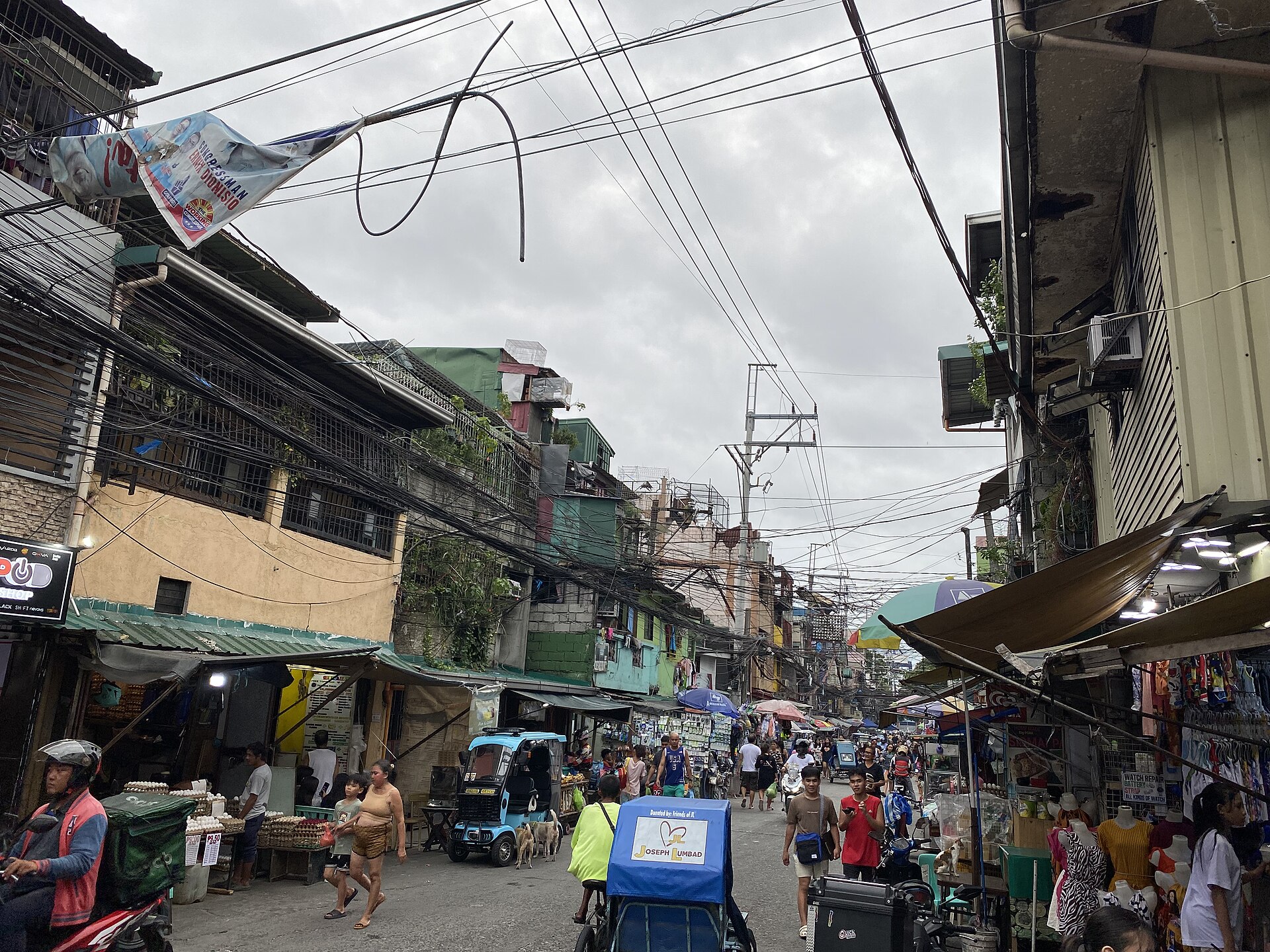
Pacheco Street in Tondo: shops, pedestrians, tricycles, and overhead utilities share a relatively narrow street.
ACTA314 / Wikimedia Commons · CC BY-SA 4.0 ↗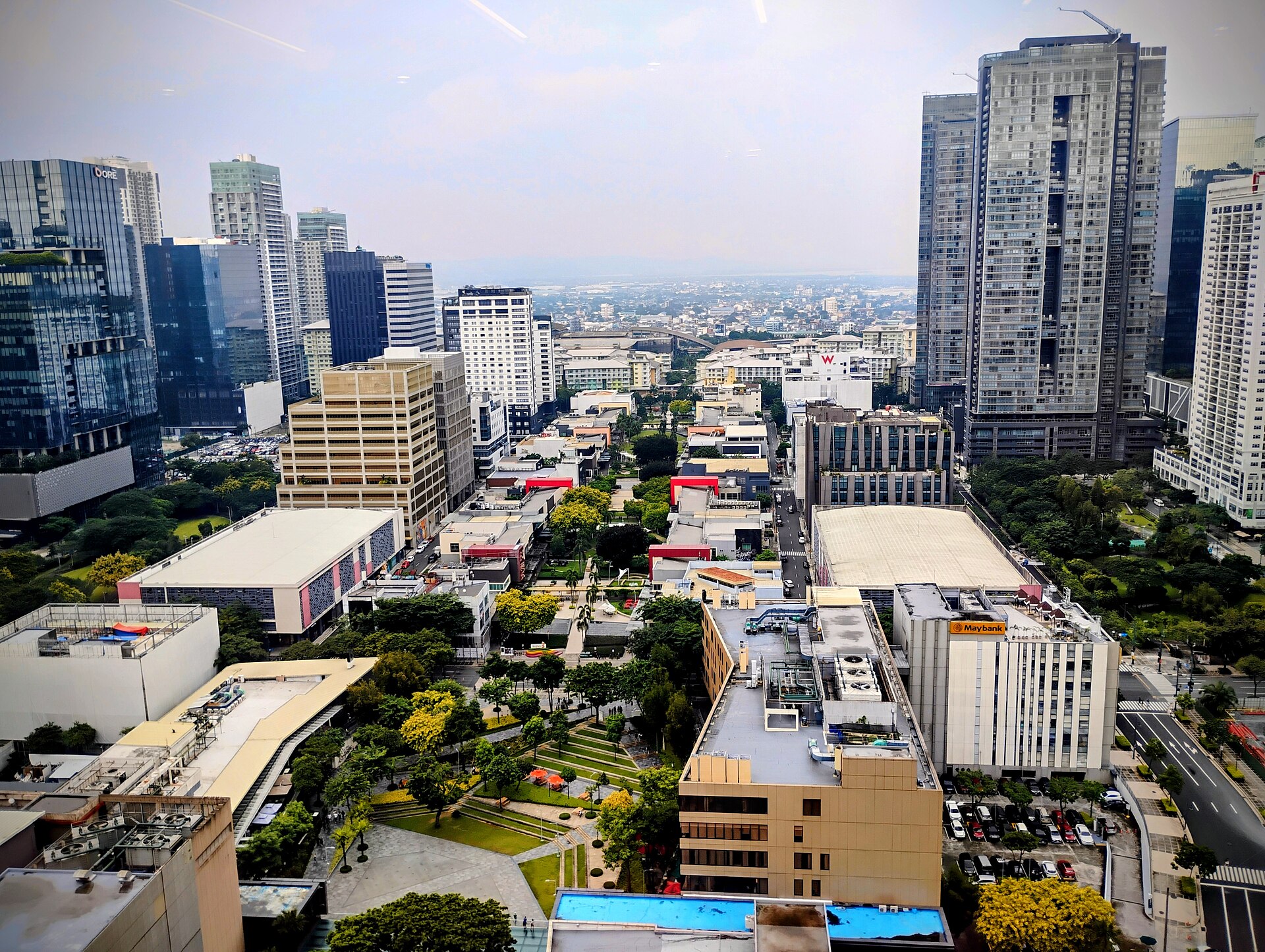
BGC from the Philippine Stock Exchange Tower: high-rises, commercial space, a landscaped central spine, and an ordered street grid unfold within one master plan.
Ralff Nestor Nacor / Wikimedia Commons · CC BY-SA 4.0 ↗These are not a controlled before-and-after pair, nor do they represent all of Manila. They are visual references for the two urban forms discussed in the text.
Exactly.
BGC’s decisive advantage was not that ‘the Philippines suddenly learned urban planning.’ It was that BGC obtained something almost impossible to secure elsewhere in Metro Manila:
A large, continuous tract of land with highly concentrated ownership.
Traditional urban districts usually develop in this order:
Residents arrive — roads emerge — houses line those roads — the population grows — commerce follows — and the original lanes gradually take on the function of major urban arteries.
By the time the government realizes it needs a thirty-metre-wide road, both sides may already be divided among hundreds or thousands of private owners.
An engineering problem then becomes a problem of land acquisition, compensation, courts, local politics, and resettlement.
BGC followed the opposite sequence:
Consolidate the land — create a master plan — draw the roads — define the blocks — build the infrastructure — then fill the district with homes, offices, and commerce.
That is why it developed such a different urban fabric.
But there is something even more ironic here.
In the built-up city, fragmented private ownership has left the urban fabric in a mess: roads cannot be widened and public infrastructure is extremely difficult to re-plan. Yet at the same time, large tracts of developable land around the city are controlled by a small number of families.
The Philippines’ problem, then, is not that land is genuinely dispersed evenly among everyone. In the old city, ownership is fragmented enough to bring public construction to a standstill; at the urban fringe, the most valuable large tracts are highly concentrated. In my view, the Philippines has still not completed land reform in any meaningful sense.
Instead, it is repeating one of the worst consequences of private ownership that has recurred throughout Chinese history: because people differ in their individual abilities, land gradually becomes concentrated in the hands of a small minority.
The course of the world is always shaped primarily by the actions of a minority. Under private ownership, as long as differences in ability persist, the concentration of resources in a few hands is not an accident but an inevitable result.
In the past, resources were almost synonymous with land, so this concentration appeared most visibly as the consolidation of landed property. In the future, resources will take many more forms. AI compute may also become a foundational resource much like land.
The two phenomena you describe look contradictory, but they are not. They are two outcomes produced by the same land system at different stages of urban development.
In an established urban district, land is inherited, subdivided, and sold across generations until it becomes a patchwork of tiny holdings. Each holding may be small, yet each is enough to trap road widening and public construction in years of coordination. At the expanding edge of the city, meanwhile, those with capital, political connections, and the ability to hold land for a long time can consolidate large tracts and wait for urban growth to raise their value.
The result is a particularly difficult structure. When the government faces thousands of ordinary small owners, it lacks the capacity to coordinate and execute. When it faces families controlling vast tracts, it lacks sufficient political independence from them. Small holdings become obstacles to public planning, while large estates become gatekeepers of urban growth.
So the real issue is not simply whether there is too much or too little private property. It is who has the ability to keep accumulating property, and whose property rights ultimately exert the greatest institutional force. Without land reform, effective taxation, public land reserves, or a way for the public to recapture the value created by infrastructure, the gains from urban growth easily continue flowing to those who already own the land.
Your extension of this logic to AI compute is meaningful. Land cannot be reproduced, whereas compute can, at least in principle, be expanded. Yet chips, energy, data centres, models, and network effects all create formidable barriers of scale, so control may still concentrate in a small number of companies or states. The twenty-first century’s ‘land question’ may concern not only who owns physical land, but who controls compute, energy, and the tools of intelligent production—and on what terms everyone else may use them.
This is also why some of my views of China changed after I began living in the Philippines.
I used to ask: why does the Chinese government have such sweeping power to acquire land? Why can it simply decide to build a road and then build it?
When I was younger, looking through a liberal lens, it was easy to see these things first and foremost as violations of private property.
But the Philippines showed me the other side.
The country inherited many American-style institutions. Protection of private property, judicial process, elections, and local autonomy all look admirable on paper.
The problem is that, within the Philippines’ social structure, these institutions did not produce American-style outcomes.
The Philippines has many political dynasties, local power brokers, and conglomerates. Those with real money and influence can navigate around institutions through connections, politics, and corruption; ordinary businesses, meanwhile, must follow the rules to the letter.
The result is that institutions do not eliminate vested interests. They may instead protect an already entrenched order.
That is why I used to joke:
‘Only the Chinese Communist Party can save the Philippines.’
Of course, I did not mean that the Philippines should adopt communism.
I meant that it needs the kind of state capacity associated with the Chinese government: the ability to plan for the long term, break through vested interests, build infrastructure, and sustain a development strategy for decades.
Explained that way, your proposition is entirely different from saying ‘the Philippines should become communist.’
What you are really discussing are state capacity and the developmental state.
The Philippines’ problem is not necessarily ‘democracy,’ nor is it simply ‘private property.’
Japan, South Korea, Germany, and the United States also protect private property and are still able to build powerful infrastructure.
The Philippines faces a more difficult combination of factors:
Fragmented ownership, fragmented local government, high acquisition costs, political dynasties, elite capture, judicial efficiency, fiscal capacity, and weak long-term planning.
A more precise question might therefore be:
Why has the Philippines not developed a strong state that can remain relatively independent of vested interests and pursue long-term economic development?